
When Regulators Failed to Defend Voluntary Informed Consent
How Australian and UK regulators allowed vaccination to proceed after the ethical precondition for consent had collapsed

Author’s note:
This article examines a fundamental ethical question that arose during the COVID vaccination rollout: what happens to medical ethics when the conditions required for voluntary informed consent no longer exist?
It does not argue for or against vaccination policy. Instead, it focuses on the role of medical regulators in Australia and the UK, and asks whether they defended the non-negotiable ethical boundary – voluntary consent – that governs all medical intervention.
The analysis draws on my correspondence with Ahpra, and a Freedom of Information request submitted by UK doctor Sarah Myhill to the General Medical Council, highlighting how two different regulatory pathways expose the same unresolved ethical failure.
During the COVID period, practitioners’ personal obligation to obtain ethically valid voluntary informed consent for vaccination ostensibly remained unchanged.
At the same time, extraordinary pressure was applied to both the public and practitioners to comply with COVID vaccination programs.
How that pressure operated differed between countries.
But the ethical problem was the same.
Over recent years, I have challenged the Australian health practitioner regulator, Ahpra, on this contradiction. More recently, UK doctor Dr Sarah Myhill has taken a related but distinct approach, submitting a detailed Freedom of Information request to the UK General Medical Council (GMC).
Her FOI can be read in full here:
👉 Freedom of Information Act Request to the GMC Concerning the COVID Vaccination Roll-Out
Sarah contacted me after reading my correspondence with Ahpra, having recognised the same unresolved ethical problem in the UK system. Rather than pursuing doctrinal clarification, she chose to force accountability through a different regulatory mechanism.
This article explains how our approaches differ, how they converge, and how both bring the same bedrock ethical principle into view.
Two approaches to the same problem
My own work has focused on forcing regulatory clarity. In Australia, I have relied on Ahpra’s own published statements to expose an unresolved contradiction: while practitioners are personally obliged to obtain voluntary informed consent, vaccination was permitted to proceed under conditions in which refusal carried the threat of serious penalties, and therefore could not be voluntary.
Sarah Myhill’s approach addresses the same problem from another direction. Rather than asking the regulator to restate principles, her FOI asks for evidence of action. It seeks to establish what the GMC actually did – and did not do – to defend informed consent during the COVID vaccination rollout.
Together, these approaches return attention to the point at which medical ethics is ultimately decided – the clinical encounter.
The shared ethical foundation
Both challenges arise from the same bedrock ethical principle, which can be stated simply:
Without voluntary informed consent, a practitioner cannot ethically proceed.
That principle does not depend on public health policy, emergency powers, or institutional reassurance. Crucially, the ethical obligation of the practitioner to obtain valid consent is personal and non-delegable. It cannot be displaced by public health policy, institutional direction, or regulatory ambiguity.
Australia – coercion through mandates and penalties
In Australia, the ethical conflict was stark.
COVID vaccination mandates were imposed across large sectors of society, including healthcare, education, construction, transport, public administration, and ordinary daily life. Refusal carried explicit penalties – loss of employment, exclusion from workplaces, restrictions on movement, and exclusion from social, cultural, and commercial participation.
Explicit penalties for refusal were in place, while at the same time Ahpra and the Commonwealth Department of Health affirmed that:
informed consent was required for every vaccination
consent must be voluntary
mandates did not override practitioners’ ethical obligations
This blatant contradiction was never addressed.
My letter to Ahpra, dated 7 January 2026, therefore poses an unavoidable question, summarised as:
If a person submits to vaccination under threat of serious penalty, can that submission still be regarded as voluntary consent?
I explicitly asked Ahpra to clarify whether it believed voluntariness survived such conditions, or whether it accepted that mandates created an ethical impossibility at the point of care.
The full letter can be read here:
👉 Letter to Ahpra re ethically valid consent
This approach deliberately corners the regulator doctrinally. It forces Ahpra either to confront the contradiction, or to redefine ‘voluntary’ in a way that undermines its own guidance.
Sarah Myhill’s approach – institutional exposure via FOI
Sarah Myhill’s FOI tackles the regulatory problem from a different angle.
Rather than asking the GMC to restate ethical principles, her request seeks documentary evidence of how informed consent was defended in practice during the COVID vaccination rollout.
In summary, Dr Myhill sets out the following position:
The GMC places a duty on itself to enable doctors to provide safe care, with safe care as defined in its own various Guidance documents. This is MUST do.
Informed Consent is within the GMC’s definition of safe care and this MUST be its overarching duty that trumps political pressures.
The GMC places a duty on doctors to follow its various Guidance documents and doctors MUST comply
ipso fatco, the GMC should have been helping and enabling doctors to give Informed Consent regarding the Covid vaccination roll out
She then poses the crucial question:
“But, what did the GMC actually do to help, enable and support doctors in this LEGAL duty of doctors to give Informed Consent that the GMC itself imposed upon doctors?”
If informed consent truly remained a professional obligation throughout the COVID period, one would expect to see a clear operational record of the regulator actively defending that obligation.
If such records are sparse or absent, that absence is itself revealing. It suggests that ethical standards were preserved rhetorically, while being allowed to collapse in practice.
This is precisely what an FOI is designed to expose – not intentions or reassurances, but what was actually done.
The UK – pressure without enduring mandates
The UK situation differed materially from Australia’s, but not in a way that removed the ethical problem.
With the exception of the short-lived Vaccination as a Condition of Deployment (VCOD), the UK did not impose the kind of widespread, long-lasting COVID vaccination mandates that were enforced across large sectors of Australian society.
As Sarah Myhill notes, VCOD:
“…was initially implemented for care home workers in November 2021 [12]. It was subsequently extended to cover all frontline health and social care workers—including doctors, nurses, and support staff with direct patient contact—with a deadline of April 1, 2022. After much pressure, the mandatory vaccination regulation was abandoned and revoked in March 2022 before it was fully implemented…”
Unlike in Australia, the proposed mandate for NHS workers was never enforced, reflecting the political and operational limits of dismissing large numbers of healthcare staff.
Yet the absence of enduring formal mandates did not mean an absence of coercive pressure.
Clinicians and other regulated health professionals in the UK practised under conditions characterised by:
sustained political messaging and moral framing around vaccination
extensive media and social-media shaming of dissenting views
statements from regulators and professional bodies strongly encouraging vaccination
implicit fitness-to-practise risk for clinicians who questioned policy
professional investigations and disciplinary action against dissenting practitioners
The ethical problem therefore did not disappear. It changed its form.
Aged care as the ethical breach point – UK and Australia
In each case, aged-care staff were framed as a risk to vulnerable residents and subjected to vaccination requirements that carried explicit consequences for refusal. The resulting coercive conditions extinguished voluntariness at the point of care.
That this occurred in parallel across jurisdictions, under different regulatory systems, underscores that the ethical problem did not arise from mandates alone, but from the failure of regulators to intervene when informed consent could no longer be freely given.
Australia – mandates imposed, consent abandoned
In Australia, aged-care workers were the first group subjected to mandatory COVID vaccination, and the point at which the principle of voluntary informed consent was decisively broken.
On 4 June 2021, the Australian Health Protection Principal Committee (AHPPC), chaired by Paul Kelly in his capacity as Chief Medical Officer, publicly stated that it did not recommend compulsory COVID vaccination for aged-care workers. On the same day, the ABC reported that Scott Morrison, then Prime Minister, intended to press National Cabinet to override that medical advice.
Less than four weeks later, on 28 June 2021, National Cabinet agreed that COVID vaccination would be mandated for residential aged-care workers as a condition of employment. The following day, the AHPPC reversed its earlier position and recommended vaccination as a condition of work.
Refusal carried explicit penalties. Aged-care workers who declined vaccination faced loss of employment and exclusion from their profession. Voluntariness was extinguished.
This decision was a political rather than a health decision, as acknowledged by the Australian Nursing & Midwifery Federation at the time. It nevertheless proceeded, and it established the template for a cascading series of vaccination mandates across healthcare and other sectors of Australian society.
Unlike in the UK, where an attempted extension of mandates to the wider healthcare workforce was withdrawn, Australian healthcare and aged-care workers were subjected to widespread and enduring mandates that were implemented and enforced. The medical profession did not collectively resist. No regulatory intervention occurred to halt mandatory vaccination on ethical grounds.
The aged-care mandate was therefore not an isolated policy decision. It was the moment at which voluntary informed consent was abandoned in practice, precipitating a broader system of coercive vaccination across the country.
The regulatory question
The question is no longer whether informed consent existed on paper.
The question is why regulators permitted mandatory vaccination to proceed without insisting on voluntary informed consent, when the conditions under which it occurred extinguished voluntariness altogether.
That question sits squarely at the centre of Sarah Myhill’s FOI to the GMC. It is the same question raised through my correspondence with Ahpra.
Conclusion – an international regulatory ethics failure
Read together, the UK and Australian experiences point to the same conclusion. This analysis does not depend on resolving disputes about national policy choices or pandemic management styles. It identifies an international regulatory ethics problem.
Across different jurisdictions, legal frameworks, and policy mechanisms, regulators permitted mandatory vaccination to proceed – a circumstance that extinguished voluntariness – while maintaining that informed consent obligations remained intact.
Whether through explicit mandates or pervasive institutional pressure, the ethical precondition governing medical intervention was not defended:
Without voluntary informed consent, a practitioner cannot ethically proceed.
The failure to enforce that boundary is not a debate about the merits of vaccination policy. This is not to suggest that public health policy should be beyond disagreement. It is to recognise that ethical preconditions governing medical practice – including vaccination – cannot be suspended by policy at all.
That is the challenge now on the record – in more than one country, and through more than one regulatory pathway. It is not about what regulators said. It is about what they allowed.
Further reading (Australia):
For readers seeking further documentation of how mandates operated in Australia, see for example the following articles which provide detailed analysis and primary-source references:


Acknowledgement
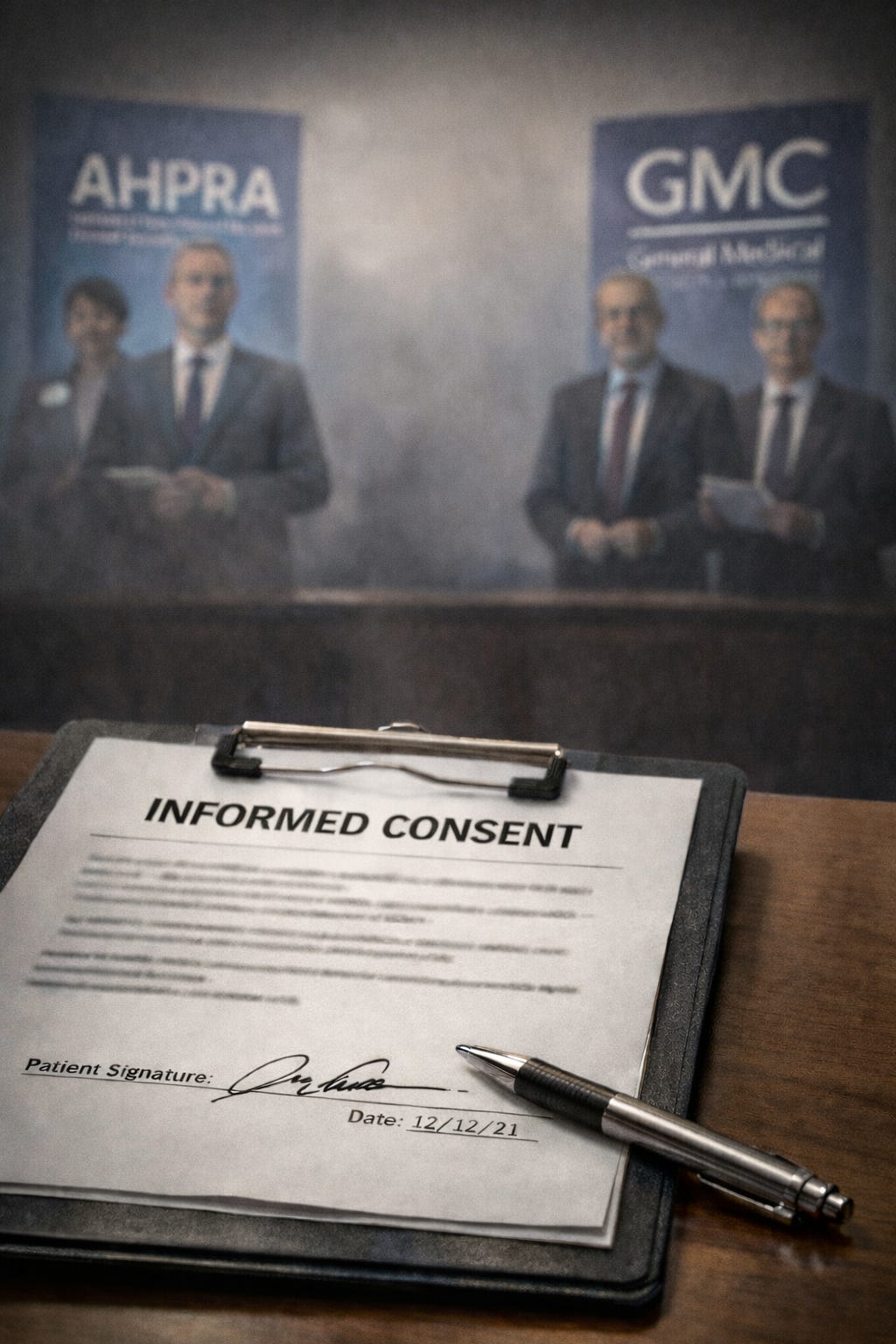
This article was developed through extensive discussion with ChatGPT, used as a reasoning partner to test ethical arguments, refine structure, and improve clarity. An accompanying graphic was generated with the assistance of AI. All analysis, positions, and conclusions are my own.
There can never be voluntary consent when your employment is threatened.
Public Health has become a weapon against the rights of the individual. One of the key principles of Public Health is a collective mindset where their perceived greater good trumps the individuals rights. All that had to be done was stage a contagious life threatening emergency where the public was at risk for the individuals right of informed consent to be swept away by the governments and public health institutions.